Why it helps to test under one roof
Being sent across town for a test means another appointment, another waiting room and results that have to find their way back to your doctor. When the test happens in the same clinic, you make fewer trips and your doctor sees the results alongside the rest of your record.
EKG (electrocardiogram)
An EKG records the electrical activity of your heart through small sticky patches placed on your chest, arms and legs. It’s painless, takes a few minutes, and nothing passes into your body.
Doctors use an EKG to look at heart rhythm, to check symptoms such as palpitations, as part of a physical, or to keep an eye on a heart condition or a medicine that can affect the heart.
Ultrasound imaging
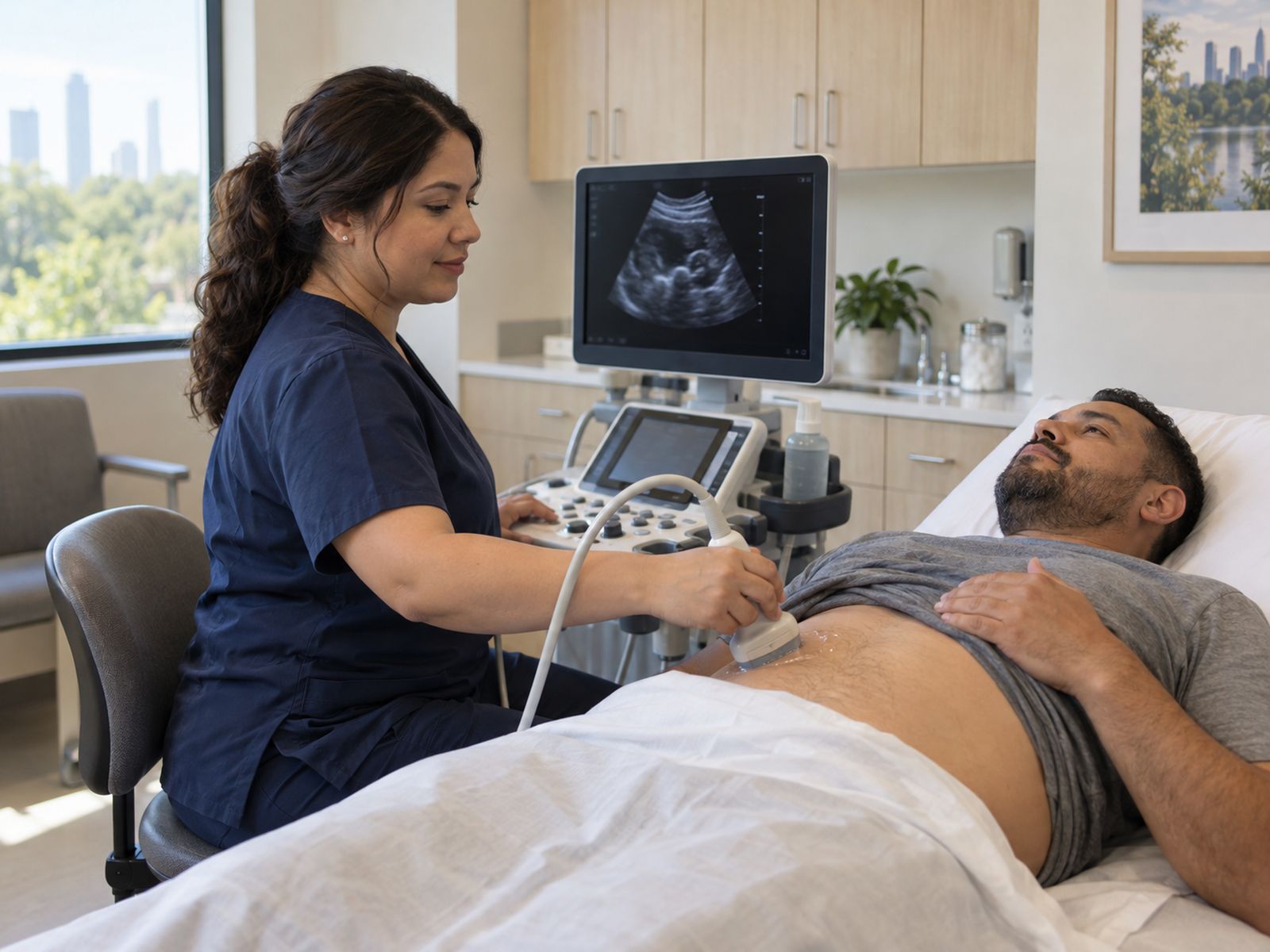
Ultrasound uses sound waves to make pictures of organs, blood vessels and soft tissue. A gel goes on your skin and a small handheld probe moves over the area. There’s no radiation.
Every ultrasound study is done here: abdominal, thyroid, vascular and pelvic scans among them. A licensed ultrasound technologist performs the scan, a board-certified radiologist reads it, and the report comes back to your doctor at V-Care.
Some scans need simple preparation, such as not eating beforehand or arriving with a full bladder, depending on the area being looked at. We’ll tell you what to do when you book.
Lab work
Blood and urine tests show a lot that an exam can’t: blood sugar, cholesterol, kidney and liver function, blood counts, thyroid levels and more. They’re how long-term conditions are tracked over time, and often the first step in working out a new symptom.
Your blood is drawn here, and the samples go to Quest Diagnostics for processing. Results are usually back within 24 hours, and your doctor goes through them with you. Most tests need no preparation. A few, such as some cholesterol and blood sugar tests, ask you to fast first, and we’ll tell you if yours does.
ANS (autonomic nervous system) testing
Your autonomic nervous system runs the things you don’t think about: heart rate, blood pressure, sweating and digestion. ANS testing measures how well these automatic controls respond, typically by tracking heart rate and blood pressure during simple steps such as deep breathing or standing up.
Your doctor may suggest it if you have symptoms such as dizziness when you stand, or a condition such as diabetes that can affect these nerves over time. The tests are typically noninvasive.
Getting a test here
Your doctor will order tests during a visit, whether that’s a physical, an urgent care visit or a follow-up. We run tests ordered by our own providers; we aren’t able to perform tests ordered by an outside physician. Most major plans are welcome, Medicare and Medicaid included; check yours on the insurance page.
Before your test
- Ask whether you need to fast, and for how long
- Ask whether to take your usual medicines beforehand
- Wear a loose top that’s easy to open or remove for an EKG or ultrasound
- Bring your insurance card and a photo ID
Common questions
Do I need to fast before blood work?
Only for some tests, such as certain cholesterol or blood sugar checks. When your labs are ordered, we’ll tell you whether to fast. If you’re unsure, call us before your appointment.
Does an EKG hurt?
No. Sticky patches are placed on your skin and the machine records your heart’s electrical signals. Nothing passes into your body, and the test takes a few minutes.
Is ultrasound safe?
Ultrasound uses sound waves, not X-rays, so there’s no radiation. You may feel light pressure from the probe, and the gel wipes off afterward.
What is ANS testing used for?
ANS testing checks how well your body controls automatic functions such as heart rate, blood pressure and sweating. Doctors use it to look into symptoms such as dizziness on standing, or to check for nerve changes linked to conditions such as diabetes.
Can I come in just for lab work?
Only for tests ordered by a V-Care provider. We don’t draw or process labs ordered by an outside physician. If you’re our patient, your doctor orders labs as part of your care and tells you how to prepare.
How long do lab results take?
Usually about 24 hours. Your sample is drawn here and processed by Quest Diagnostics, and your doctor goes through the results with you once they’re back.
Who reads my ultrasound?
A licensed ultrasound technologist performs the scan here in the clinic, and a board-certified radiologist reads it. The report comes to your V-Care doctor, who explains what it means for you.